
USCIS May Now Deny Incomplete Immigration Filings Without First Issuing an RFE or NOID
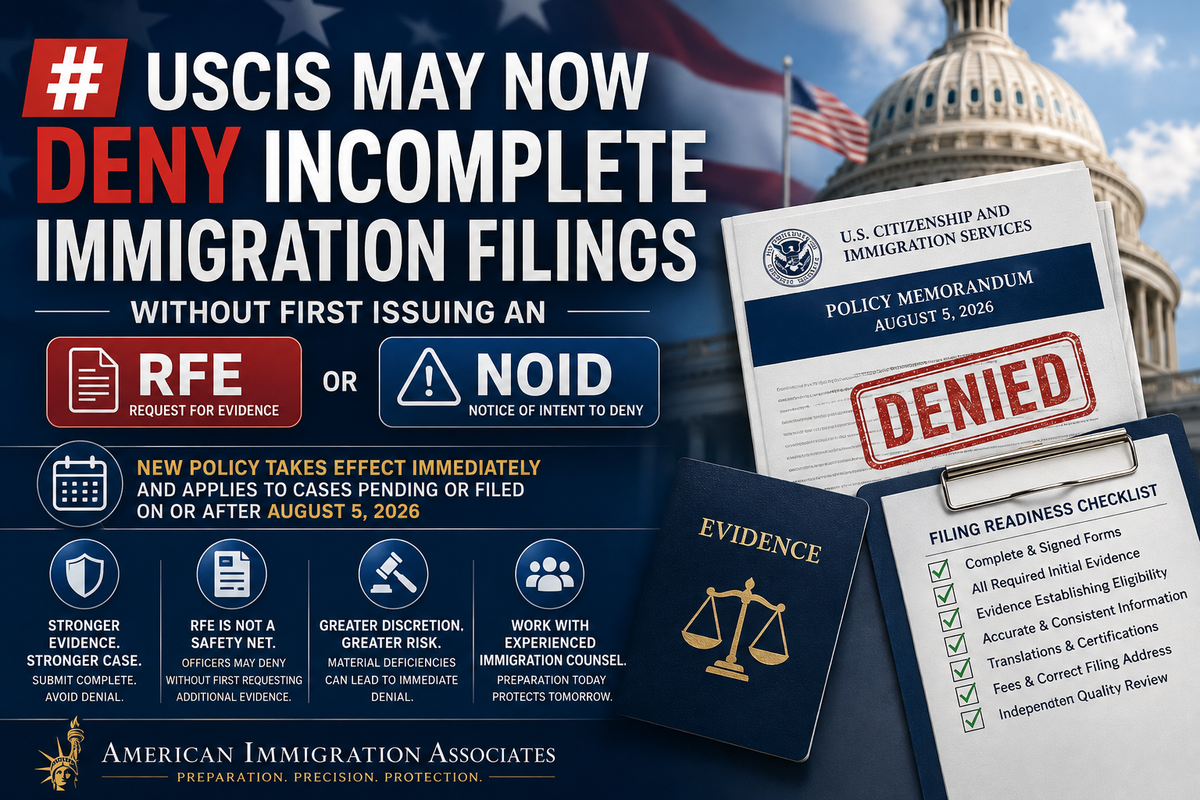
New policy takes effect immediately and applies to cases pending or filed on or after August 5, 2026
U.S. Citizenship and Immigration Services has announced a significant change in how the agency may adjudicate incomplete or insufficient immigration benefit requests.
Effective August 5, 2026, USCIS officers have restored discretion to deny certain applications and petitions without first issuing a Request for Evidence, commonly known as an RFE, or a Notice of Intent to Deny, known as a NOID.
The updated policy applies to immigration benefit requests that are pending on or filed on or after August 5, 2026, unless a regulation or another USCIS policy provides otherwise.
The practical message from USCIS is clear: applicants and petitioners should establish eligibility and submit all required initial evidence at the time of filing. An RFE or NOID should no longer be treated as an opportunity to complete an application that was materially deficient when submitted.
What Changed?
Under the prior policy, USCIS officers were generally encouraged to issue an RFE or NOID when additional evidence could potentially establish eligibility. This frequently gave applicants and petitioners an opportunity to correct deficiencies, clarify inconsistencies, or submit documents that had been omitted from the original filing.
The new policy restores broader discretion to USCIS officers. An officer may now deny a benefit request without first requesting additional evidence when the applicant or petitioner:
- Fails to establish eligibility for the requested immigration benefit at the time of filing;
- Does not submit evidence specifically required by the applicable form instructions;
- Files a materially incomplete application or petition;
- Leaves required questions unanswered or fails to provide necessary signatures;
- Submits evidence that does not support the requested classification or benefit; or
- Files what USCIS considers a “placeholder” request primarily to obtain an associated benefit while waiting to develop the underlying case.
USCIS stated that the change is intended to discourage frivolous or substantially incomplete filings, protect the integrity of the immigration system, and prevent deficient cases from delaying properly prepared applications.
The full USCIS policy update is available in the agency’s August 5, 2026 policy memorandum.
An RFE Is No Longer a Safety Net
Applicants should never assume that USCIS will issue an RFE before denying a case.
An RFE is not a guaranteed second opportunity to establish eligibility. Similarly, a NOID is not required in every case before USCIS issues an unfavorable decision.
Under the updated policy, the absence of required initial evidence may result in an immediate denial, even if the missing documents could have been obtained and submitted later.
This creates heightened risks for cases filed quickly because of an approaching deadline, expiring immigration status, aging-out concerns, visa availability, employment authorization needs, or other urgent circumstances.
Filing before a case is ready may preserve a deadline in some circumstances, but it may also expose the applicant to denial if the submission does not satisfy the applicable evidentiary requirements. Each urgent filing must therefore be evaluated individually by qualified immigration counsel.
What Is “Required Initial Evidence”?
Required initial evidence varies according to the immigration benefit requested. USCIS form instructions generally identify the documents that must accompany each application or petition.
Depending on the case, required initial evidence may include:
- Properly completed and signed forms;
- The correct form edition and filing fee;
- Proof of the petitioner’s or applicant’s identity;
- Evidence of lawful admission and maintenance of immigration status;
- Employment agreements, itineraries, support letters, and wage information;
- Corporate formation and business-operating documents;
- Proof of the qualifying family relationship;
- Civil documents, including birth, marriage, and divorce records;
- Certified English translations;
- Educational credentials and credential evaluations;
- Evidence supporting the applicable employment-based eligibility criteria;
- Financial records and affidavits of support; and
- Evidence establishing eligibility for any requested waiver or exception.
Submitting a large volume of documents does not necessarily establish eligibility. The evidence must be relevant, reliable, internally consistent, and connected to the legal requirements for the requested benefit.
Pending Cases Are Also Affected
The policy is not limited to applications filed after the announcement.
According to USCIS, the updated standards also apply to qualifying benefit requests that were already pending on August 5, 2026. Applicants and petitioners with pending matters should therefore not assume that USCIS will issue an RFE before denying a case containing material evidentiary deficiencies.
When appropriate and legally permitted, counsel may consider whether a supplemental submission should be made before USCIS adjudicates the case. However, unsolicited evidence must be handled carefully because additional documents can create new inconsistencies or inadvertently disclose information that affects eligibility.
A supplemental filing should only be submitted after a complete review of the case record.
Greater Risk for “Placeholder” Applications
USCIS specifically expressed concern about applications filed without sufficient supporting evidence for the purpose of creating a pending case and obtaining associated benefits, such as employment authorization.
Under the new policy, filings perceived as placeholders may face increased scrutiny and possible denial without an RFE or NOID.
Applicants should understand that obtaining a receipt notice does not mean USCIS has determined that the filing is complete, approvable, or supported by sufficient evidence. A receipt only confirms that USCIS accepted the submission for processing.
What Applicants and Employers Should Do
Before filing an immigration application or petition, applicants, employers, and legal representatives should conduct a comprehensive filing-readiness review.
The review should confirm that:
- The correct immigration benefit and filing strategy have been selected.
- Every required form is complete, current, properly signed, and internally consistent.
- The requested dates, addresses, employment terms, and biographical information match throughout the filing.
- All required initial evidence identified in the form instructions is included.
- The evidence establishes every legal element of eligibility as of the filing date.
- Translations and certifications satisfy USCIS requirements.
- Prior immigration filings, entries, departures, status violations, employment history, and government records have been reconciled.
- Any potentially adverse fact has been reviewed and addressed before filing.
- The filing fees and submission address have been verified immediately before dispatch.
- The final submission has undergone an independent quality-control review.
Applicants should also preserve a complete copy of everything submitted to USCIS, including the forms, supporting evidence, payment confirmation, delivery record, and final assembled PDF.
Careful Preparation Is More Important Than Ever
The policy does not mean that USCIS will deny every case containing a minor omission, nor does it eliminate RFEs or NOIDs. Officers retain discretion, and certain regulations or specific USCIS policies may still require additional procedural steps before a denial.
Nevertheless, the change substantially increases the consequences of submitting an incomplete or poorly documented case.
A rushed filing, inconsistent evidence, missing initial documentation, or reliance on a future RFE may now lead directly to denial. Such a denial can result in lost filing fees, processing delays, interruption of employment authorization, immigration-status complications, or the need to submit an entirely new case.
The strongest protection is a complete, accurate, and legally sufficient filing from the beginning.
American Immigration Associates carefully evaluates each matter to ensure that the forms, legal arguments, and supporting evidence are properly coordinated before submission. Individuals and employers preparing an immigration filing—or concerned about a case already pending with USCIS—should seek individualized legal guidance regarding the potential effect of this policy.
This article is provided for general informational purposes and does not constitute legal advice. Immigration outcomes depend on the specific facts, procedural history, and applicable law governing each case.