
USCIS Asylum Interview Rule: Cases May Go to Court Without Interview
Meta title: USCIS Asylum Interview Rule: Cases May Go to Court Without Interview
Meta description: USCIS has changed the affirmative-asylum process, allowing certain cases to be referred to immigration court without a USCIS interview. Learn what the rule may mean for applicants.
Suggested URL: /uscis-asylum-cases-without-interview-rule/
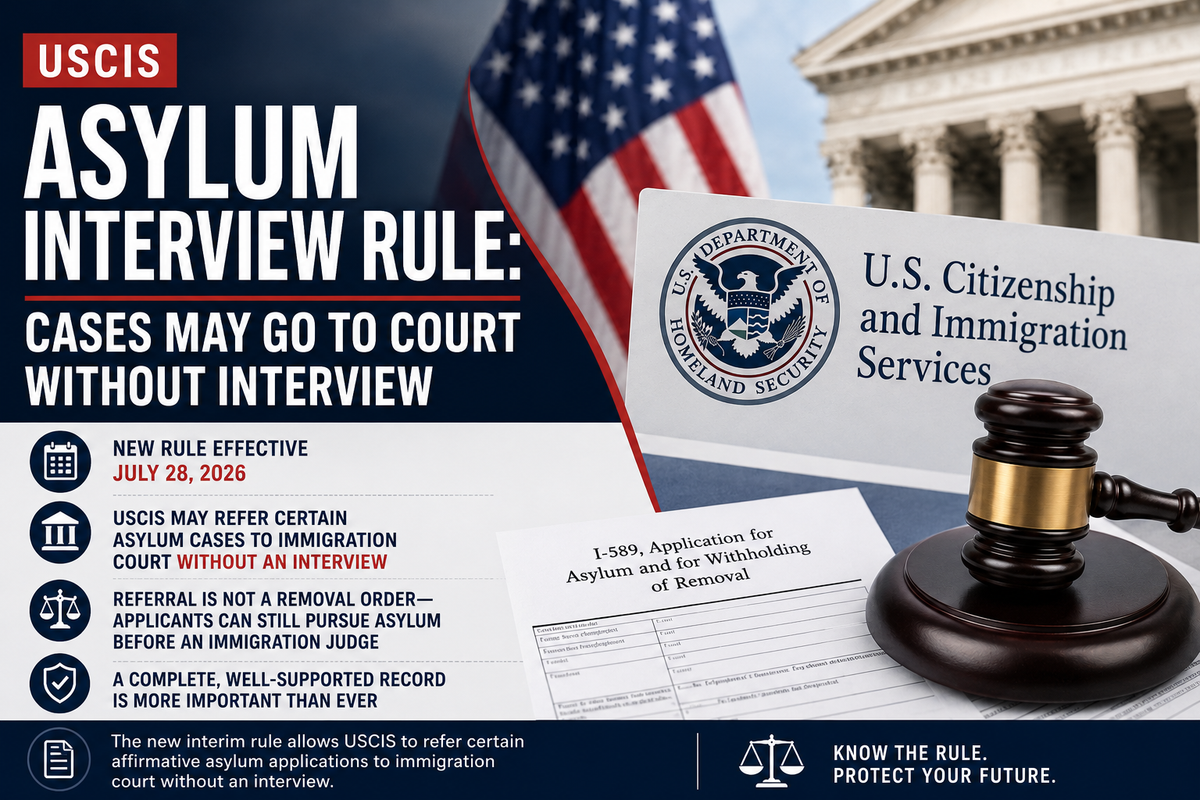
The U.S. Citizenship and Immigration Services (USCIS) has adopted an interim rule that changes how certain affirmative asylum applications may be processed. Under the new policy, USCIS may refer some asylum cases directly to immigration court without first conducting an interview with the applicant.
The rule took effect on July 28, 2026. It applies to certain affirmative asylum applications filed with USCIS on Form I-589, Application for Asylum and for Withholding of Removal.
What Is Changing in the Affirmative Asylum Process?
Traditionally, an individual pursuing affirmative asylum through USCIS would be scheduled for an interview with an asylum officer. Following that interview, USCIS could grant asylum or, if the application was not approved and the applicant did not have lawful immigration status, refer the case to immigration court.
The new interim rule permits USCIS to refer certain cases to an immigration judge based on the written record, without first holding an asylum interview.
This does not mean that every affirmative asylum applicant will lose the opportunity for an interview. USCIS retains the ability to schedule interviews, and the agency has stated that the change is intended to address cases where the record indicates that an applicant may be barred from asylum, ineligible for relief, or otherwise unsuitable for a discretionary grant.
Which Cases May Be Affected?
Under the rule, USCIS may refer an affirmative asylum application to immigration court without an interview when the agency concludes, based on the available record, that the applicant:
- Is barred from applying for asylum;
- Is barred from receiving asylum;
- Does not merit asylum as a matter of discretion; or
- Is not eligible for asylum on the merits of the claim.
The practical application of these standards will be important. Asylum eligibility can turn on complex factual and legal issues, including the one-year filing deadline, statutory bars, prior immigration history, criminal history, prior persecution, country conditions, and the relationship between the claimed harm and a protected ground.
Referral to Court Is Not an Automatic Removal Order
A referral to immigration court is not the same as a final denial of an asylum claim or a removal order.
When USCIS refers an applicant to immigration court, the applicant may pursue asylum defensively before an immigration judge. The immigration court process is separate from the affirmative-asylum process and generally involves proceedings before both an immigration judge and, if applicable, Department of Homeland Security counsel.
However, a court referral can materially change the case. It may introduce new filing obligations, court deadlines, evidentiary requirements, and procedural risks. It can also affect an applicant’s strategy, the timing of work authorization issues, and the need to prepare for removal proceedings.
USCIS’s Rationale and the Legal Context
USCIS has described the rule as a measure to reduce the affirmative-asylum backlog and improve efficiency. The agency’s position is that applicants do not have an absolute statutory entitlement to a USCIS asylum interview before a referral to immigration court.
Advocates and practitioners, however, have raised concerns that asylum interviews provide applicants a meaningful opportunity to explain their experiences in a non-adversarial setting before their cases enter removal proceedings. They also note that factual issues such as credibility, trauma, translation, and country conditions may be difficult to evaluate solely through a written filing.
Because the rule was issued as an interim final rule, it became effective immediately while the government accepts public comments. Further agency guidance and potential litigation may shape how broadly USCIS applies the new procedure.
Considerations for Asylum Applicants
Applicants with pending or planned affirmative asylum applications should focus on submitting a complete, consistent, and well-supported record at the earliest possible stage. Particular attention should be given to:
- The one-year filing deadline and any applicable exception;
- A detailed declaration addressing past harm and fear of future persecution;
- Corroborating evidence, including identity, country-conditions, medical, police, and witness records where available;
- Any possible asylum bars or discretionary issues; and
- Maintaining updated address information with USCIS and, if a case is referred, with the immigration court.
Each asylum matter is fact-specific. A referral to immigration court may create significant procedural consequences, but it does not by itself determine whether an applicant ultimately qualifies for asylum or another form of protection.
This article is provided for general informational purposes only and does not create an attorney-client relationship.
Sources
- USCIS announcement: https://www.uscis.gov/newsroom/news-releases/uscis-announces-rule-change-to-asylum-system-to-reduce-backlog
- Federal Register interim rule: https://www.federalregister.gov/documents/2026/07/28/2026-15190/affirmative-asylum-referrals-without-interview
- The Hill report: https://thehill.com/policy/national-security/5994742-trump-administration-cuts-asylum-interviews/