
U.S. Makes Visa Bond Program Permanent — Brazil Is Not Included
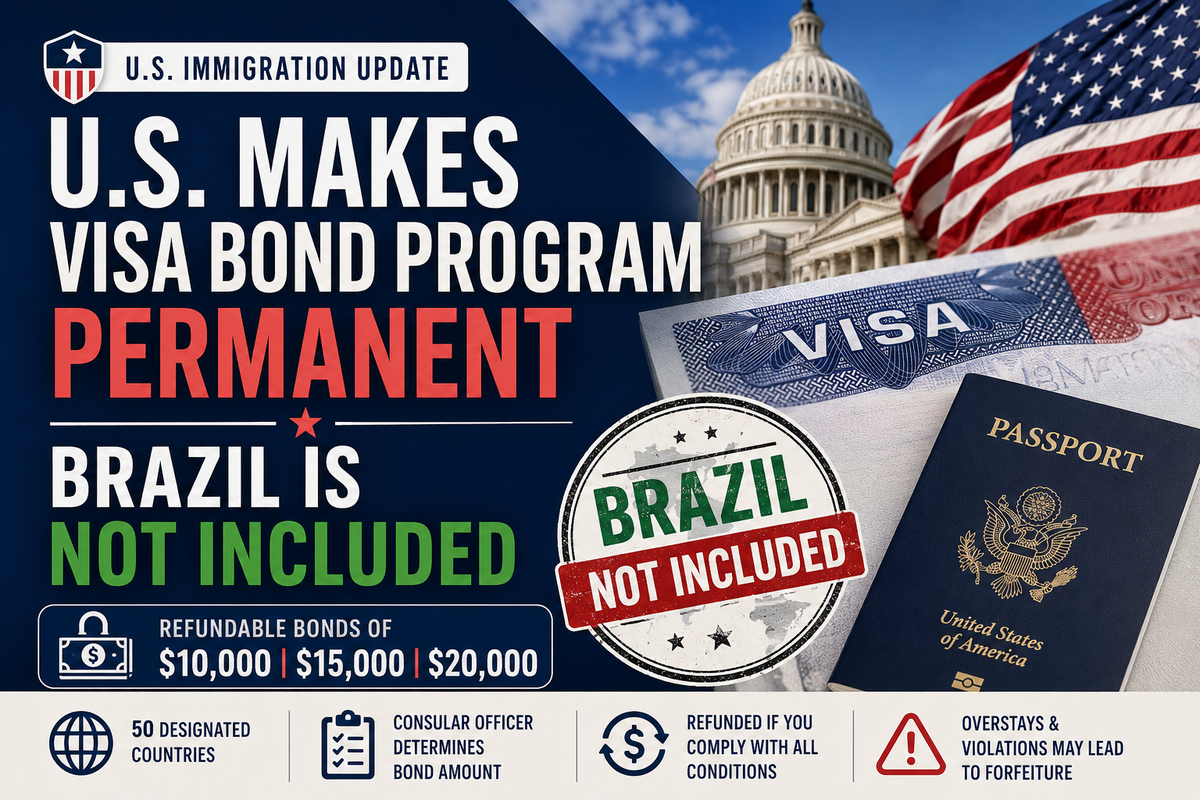
The permanent program requires certain B-1/B-2 visa applicants from 50 designated countries to post refundable bonds of $10,000, $15,000, or $20,000.
The U.S. Department of State made its Visa Bond Program permanent on August 3, 2026. The program affects certain applicants seeking B-1 business visas, B-2 tourist visas, or combined B-1/B-2 visitor visas.
Brazil is not included in the Visa Bond Program’s current list of 50 designated countries. Brazilian citizens applying with Brazilian passports are therefore not subject to this visa-bond requirement solely because of their nationality.
Brazilian applicants must still satisfy the usual eligibility requirements for a U.S. visitor visa, pay the standard application fee, attend an interview when required, and demonstrate that their proposed visit is temporary. The exclusion from the bond list does not guarantee visa approval.
What changed on August 3, 2026?
The final rule replaced a 12-month pilot program launched in August 2025. It made the Visa Bond Program permanent and established three possible bond amounts:
- $10,000
- $15,000
- $20,000
The pilot program previously used amounts of $5,000, $10,000, and $15,000.
According to the final rule, consular officers are generally expected to set a bond at $15,000. An officer may set it at $10,000 when the applicant’s circumstances support a lower amount or at $20,000 when a higher bond is considered necessary.
The official legal authority is the State Department’s August 3, 2026 final rule.
Which countries are currently affected?
As of August 4, 2026, the State Department lists the following 50 countries:
Africa
- Algeria
- Angola
- Benin
- Botswana
- Burundi
- Cabo Verde
- Central African Republic
- Côte d’Ivoire
- Djibouti
- Ethiopia
- Gabon
- The Gambia
- Guinea
- Guinea-Bissau
- Lesotho
- Malawi
- Mauritania
- Mauritius
- Mozambique
- Namibia
- Nigeria
- São Tomé and Príncipe
- Senegal
- Seychelles
- Tanzania
- Togo
- Tunisia
- Uganda
- Zambia
- Zimbabwe
Asia
- Bangladesh
- Bhutan
- Cambodia
- Kyrgyz Republic
- Mongolia
- Nepal
- Tajikistan
- Turkmenistan
Caribbean and Latin America
- Antigua and Barbuda
- Cuba
- Dominica
- Grenada
- Nicaragua
- Venezuela
Pacific and Oceania
- Fiji
- Papua New Guinea
- Tonga
- Tuvalu
- Vanuatu
Europe and Eurasia
- Georgia
Brazil does not appear anywhere on this list.
The State Department may modify the list. New countries can be added after at least 15 days’ notice, while countries can be removed with immediate effect. Applicants should check the official Countries Subject to Visa Bonds page before applying.
Why are these countries subject to visa bonds?
The Department of State may designate countries based on factors including:
- High B-1/B-2 visa overstay rates
- Deficient information sharing with the United States
- Insufficient identity-verification or criminal-history records
- Weaknesses in screening and vetting
- Concerns about the security of passports, travel documents, or civil records
- Certain citizenship-by-investment practices
Visa Waiver Program countries are excluded from designation under the final rule.
Is every applicant from a listed country required to pay?
Applicants from a designated country who fall within the program and are otherwise eligible for a B-1/B-2 visa must generally post the bond as a condition of visa issuance.
The consular officer determines the amount after considering the applicant’s individual circumstances, including:
- Purpose of travel
- Employment and income
- Education and professional skills
- Ability to pay for the trip
- Contacts in the United States
- Factors affecting the likelihood of timely departure
There is no application process for requesting a waiver. A consular officer may recommend one only in very limited circumstances involving a significant U.S. national or humanitarian interest. The final decision is made by the Assistant Secretary for Consular Affairs or an authorized designee.
What does this mean for Brazilian applicants?
Brazilian citizens applying with Brazilian passports remain subject to the regular B-1/B-2 visa process, but the current nationality-based Visa Bond Program does not apply to them.
In practical terms, a Brazilian applicant should not be instructed to pay a $10,000, $15,000, or $20,000 bond merely because the applicant is Brazilian.
However, nationality and passport details matter. Someone who is also a national of a designated country should confirm which passport is being used and obtain case-specific guidance from the relevant U.S. embassy or consulate.
Applicants should also distinguish this program from other possible immigration bonds authorized under U.S. law. Brazil’s absence from this particular country list does not eliminate every form of bond that might arise in a different immigration context.
How is a visa bond paid?
Applicants must first complete the standard visitor-visa process and attend their consular interview. If the program applies, the consular officer will provide official instructions and a government payment link.
Applicants should never pay a supposed visa bond:
- Before receiving instructions from a consular officer
- Through an immigration agent or travel agency
- Through social media or a messaging application
- Through an unofficial website
- To an individual claiming to represent the U.S. government
Payment must be made electronically in U.S. dollars through the official Visa Bond Program payment platform. Depending on the applicant’s location, available methods may include bank transfer, credit or debit card, or a digital wallet.
Paying a bond does not guarantee that the visa will be issued. If a bond is posted and the consular officer later determines that the applicant is ineligible for the visa, the bond will be canceled and the principal returned.
When is the bond refunded?
The principal is returned when the traveler substantially complies with all the bond’s conditions. Generally, the traveler must:
- Follow the conditions of the visa and immigration status
- Avoid unauthorized employment
- Leave the United States on or before the authorized departure date
- Use a qualifying commercial airport or CBP Preclearance location
- Follow the requirements governing any approved extension or change of status
The refund is issued in U.S. dollars, normally to the original payment method. The government does not pay interest. Currency-conversion expenses, processing charges, and bank fees may not be refunded.
Travelers should rely on the authorized departure date shown in their Form I-94 record—not simply the expiration date printed on the visa.
When can the bond be forfeited?
The entire bond may be forfeited following a substantial violation of its conditions. Examples identified in the final rule include:
- Remaining in the United States beyond the authorized stay
- Accepting unauthorized employment
- Filing an untimely request to extend or change status
- Failing to leave within 10 days after denial of a timely extension or change-of-status request
- Filing Form I-589 for asylum or withholding of removal
A Department of Homeland Security determination that a bond was breached may be appealed under the applicable procedures.
Bonded visas may have restricted validity
A visa issued under the program may be valid for:
- Three months and one entry
- Three months and multiple entries
- Up to 12 months and multiple entries
Bonded travelers must enter and depart through qualifying commercial airports or approved CBP Preclearance locations so the government can electronically verify their travel.
Why was the program made permanent?
The State Department reported that approximately 20,000 visa applications became subject to the bond during the pilot program and that close to half resulted in payment. Approximately $115 million was temporarily deposited.
The Department also reported fewer than 50 overstays among the designated countries during the pilot’s first 10 months, compared with 45,488 overstays attributed to those countries during fiscal year 2024. It reported an 83% reduction in B-1/B-2 visa issuance from covered countries compared with the corresponding period a year earlier.
These are the State Department’s findings supporting the final rule and should not be treated as an independent assessment of the policy’s effectiveness or wider consequences.
The bottom line
The permanent Visa Bond Program can require eligible B-1/B-2 applicants from 50 designated countries to post $10,000, $15,000, or $20,000 before a visa is issued.
Brazil is not one of those 50 countries. Brazilian citizens using Brazilian passports are not presently subject to the program based solely on their Brazilian nationality.
Because the country list can change, applicants should verify the latest information directly through Travel.State.Gov before applying, paying money, or making travel plans.
This article is for general informational purposes and is not legal advice. Applicants with prior overstays, status violations, multiple nationalities, or complicated immigration histories should consult a qualified U.S. immigration attorney.