
Trump Birth Tourism Order: Tourist Visa Changes
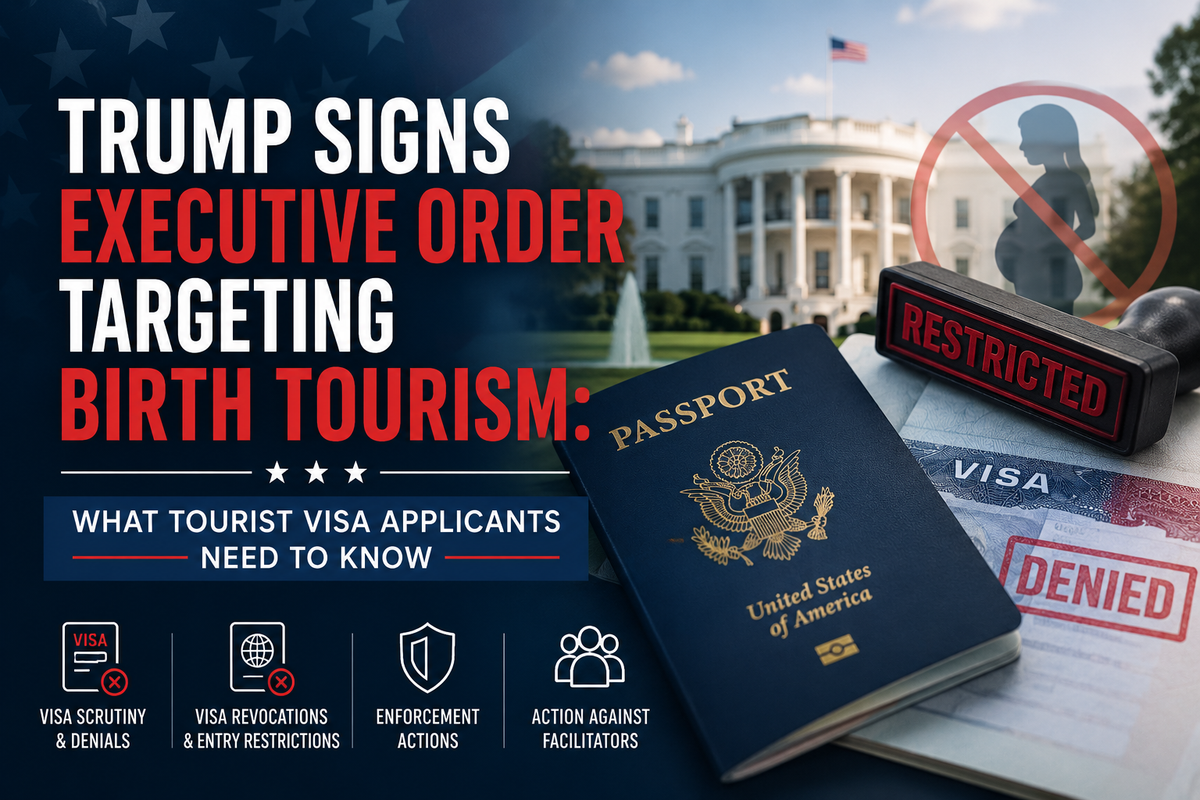
Trump’s 2026 birth tourism executive order could bring stricter visa screening, revocations and entry restrictions. Learn what it means for travelers.
URL slug: /trump-birth-tourism-executive-order-tourist-visas
Primary keyword: Trump birth tourism executive order
Secondary keywords: birth tourism visa restrictions, tourist visa pregnancy, B-2 visa birth tourism, pregnant travelers to the United States, new tourist visa rules 2026, U.S. visa revocation
Suggested excerpt: President Trump’s August 6, 2026 executive order directs federal agencies to strengthen restrictions against birth tourism. Here is what the order says—and what it does not say.
Trump Signs Executive Order Targeting Birth Tourism: What Tourist Visa Applicants Need to Know
President Donald Trump signed an executive order titled “Ending Birth Tourism” on August 6, 2026. The order directs the Department of State and Department of Homeland Security to strengthen restrictions against foreign nationals who use nonimmigrant visas to enter the United States for the purpose of giving birth on American soil.
The order could result in additional visa scrutiny, visa denials or revocations, entry restrictions, removal proceedings, and enforcement against businesses or individuals that facilitate birth-tourism arrangements.
However, the order does not state that pregnancy by itself makes a person ineligible for a tourist visa or admission to the United States.
What does the new birth tourism executive order do?
The executive order declares it U.S. policy to prevent nonimmigrant visa classifications from being used for birth tourism.
It delegates presidential authority to the Secretary of State and Secretary of Homeland Security and directs both departments to update their rules, policies, operational guidance, or other instructions as necessary.
According to the order, possible agency actions may include:
- Preventing the issuance of a visa or travel authorization to someone attempting to engage in birth tourism;
- Preventing that person’s entry into the United States;
- Revoking an existing visa or travel authorization;
- Permanently barring entry in appropriate cases;
- Denying entry to or removing someone who previously engaged in, or plans to engage in, birth tourism; and
- Taking action against individuals, organizations, or businesses that facilitate birth tourism inside or outside the United States.
These are authorized potential actions. The order does not say that every consequence will automatically apply in every case. Implementation will depend on subsequent Department of State and DHS rules, policies, and enforcement decisions.
The complete order is available from the White House.
How does the order define birth tourism?
The executive order defines “birth tourism” as:
- A foreign national entering the United States using a nonimmigrant visa for the purpose of giving birth on American soil; or
- A foreign national helping another foreign national enter the United States on a nonimmigrant visa for that purpose.
The definition is broad enough to reach not only travelers but also people and businesses that arrange or facilitate birth-tourism services.
The order specifically discusses operators that advertise citizenship-related benefits, arrange accommodations, and coach clients to misrepresent their purpose of travel to consular or border officials.
Is pregnancy now prohibited for tourist visa holders?
No. The executive order does not establish a general prohibition against pregnant people applying for visas or traveling to the United States.
The central issue is the purpose of the trip.
A person may have a legitimate reason to travel while pregnant, such as tourism, visiting relatives, attending an event, or receiving appropriate medical treatment. Nevertheless, the traveler must qualify for the requested visa, disclose material information truthfully, and satisfy the inspecting officer that the planned visit is lawful and temporary.
Pregnancy alone is not the same as birth tourism. Misrepresenting the reason for travel, however, may create serious immigration consequences.
Was birth tourism already restricted before this order?
Yes. The Department of State adopted a rule in January 2020 providing that travel primarily to give birth in the United States so that the child obtains U.S. citizenship is not a permissible basis for issuing a B visitor visa.
Under that rule, a consular officer must deny a B visa when the officer has reason to believe the applicant’s primary purpose is birth tourism.
Applicants traveling primarily for medical treatment may also be asked to demonstrate:
- The nature of the requested medical treatment;
- That a U.S. medical provider has agreed to provide the treatment;
- The projected duration and cost; and
- The applicant’s ability to pay all medical, transportation, and living expenses.
The 2026 executive order builds on this existing visa rule by directing federal agencies to consider broader enforcement measures.
The current visitor-visa guidance is available from the U.S. Department of State.
Can a tourist visa be denied or revoked under the order?
The executive order authorizes the Department of State and DHS to consider visa denials, revocations, and travel restrictions against people believed to be participating in birth tourism.
A visa does not guarantee admission to the United States. Even with a valid visa, Customs and Border Protection determines whether a traveler is admissible at the port of entry.
Officers may examine the traveler’s stated purpose, length of stay, financial arrangements, medical plans, travel history, communications, and supporting documentation.
Inconsistent or misleading answers during a visa application or border inspection can create problems that extend beyond the immediate trip.
Does the order permit permanent entry bans?
The order says agency actions may include permanently barring a foreign national who enters or attempts to enter the United States for birth tourism.
This language does not mean that every suspected case automatically results in a permanent bar. Agencies must still act within their respective legal authority, and the consequences will depend on the facts, applicable immigration law, agency guidance, and any available review process.
Travelers should obtain individualized legal advice before making assumptions about how this provision applies to a specific case.
Does the order target birth tourism companies?
Yes. The order authorizes appropriate action against entities, organizations, or individuals—whether located inside or outside the United States—that facilitate or enable birth tourism.
This may affect:
- Travel agencies;
- Maternity or birth-tourism businesses;
- Housing providers participating in organized schemes;
- Consultants who coach applicants to provide false answers;
- Brokers arranging travel or medical services; and
- Other individuals who knowingly facilitate prohibited activity.
The exact enforcement mechanisms will depend on future agency policies and existing statutory authority.
Are humanitarian exceptions available?
Yes. The order allows the Secretary of State or Secretary of Homeland Security to exempt a foreign national on humanitarian grounds or when admission is considered to be in the national interest.
The order does not explain how a traveler should request an exemption or what evidence will be required. Additional agency guidance may address those questions.
Does the order eliminate birthright citizenship?
The “Ending Birth Tourism” order primarily concerns visas, travel authorization, entry, removal, and enforcement against facilitators. It does not itself provide that every child born to a visitor loses U.S. citizenship.
President Trump signed a separate executive order on the same date addressing the administration’s interpretation of birthright citizenship in certain categories.
Because the citizenship order raises distinct constitutional and legal questions, it should not be treated as identical to the birth-tourism visa order.
What should tourist visa applicants do now?
Applicants and travelers should:
- State the true purpose of travel on the DS-160 and during the visa interview.
- Avoid incomplete, inconsistent, or misleading answers.
- Confirm that the requested visa category matches the actual planned activity.
- Carry documentation supporting the purpose and temporary nature of the trip.
- Be prepared to explain how all travel, medical, and living expenses will be paid.
- Avoid agencies or consultants that recommend hiding a pregnancy or giving false information.
- Monitor new guidance from the Department of State, DHS, and Customs and Border Protection.
- Consult an immigration attorney when the trip involves medical treatment, a prior visa problem, previous birth-related travel, or possible allegations of misrepresentation.
Frequently asked questions
Did President Trump sign a new executive order about birth tourism?
Yes. President Trump signed the “Ending Birth Tourism” executive order on August 6, 2026.
Does the order apply only to B-2 tourist visas?
The order refers broadly to entry using a nonimmigrant visa for the purpose of giving birth on American soil. Future agency guidance may clarify how it will be applied across particular visa classifications.
Can a pregnant person still visit the United States?
The order does not prohibit all pregnant travelers. Eligibility depends on the true purpose of the trip, the requested visa category, truthful disclosure, and the traveler’s admissibility.
Can someone travel to the United States for medical treatment?
Medical treatment can be a permissible B-2 purpose, but applicants may need to document the proposed treatment, medical provider, estimated cost, and ability to pay. Travel primarily to give birth so that a child obtains U.S. citizenship is not permissible on a visitor visa.
Can the government revoke an existing visa?
The executive order identifies visa or travel-authorization revocation as a possible enforcement action in birth-tourism cases.
When do the new rules take effect?
The order was signed on August 6, 2026, and directs the Department of State and DHS to update relevant rules and guidance. Because the order does not establish a detailed implementation timetable, travelers should monitor subsequent agency announcements.
Conclusion
The August 6 executive order signals a broader and potentially more severe enforcement approach toward birth tourism. Its reach may extend beyond visa denial to revocation, entry restrictions, removal, permanent bars in appropriate cases, and action against facilitators.
At the same time, the order should not be mischaracterized as a universal ban on travel by pregnant people. The controlling questions remain the traveler’s actual purpose, the accuracy of the information provided, and compliance with U.S. immigration law.
Anyone whose travel may involve pregnancy, childbirth, or medical treatment should obtain advice based on their individual circumstances before submitting a visa application or traveling.
This article provides general information and does not constitute legal advice. Immigration policies and implementation guidance may change after publication.
Sources:
- Executive Order: Ending Birth Tourism — White House
- White House Fact Sheet on Birth Tourism
- U.S. Department of State Visitor Visa Guidance
- Associated Press coverage