
Proposed Visa Fees Put the U.S. Student-to-Work Pathway Under Review
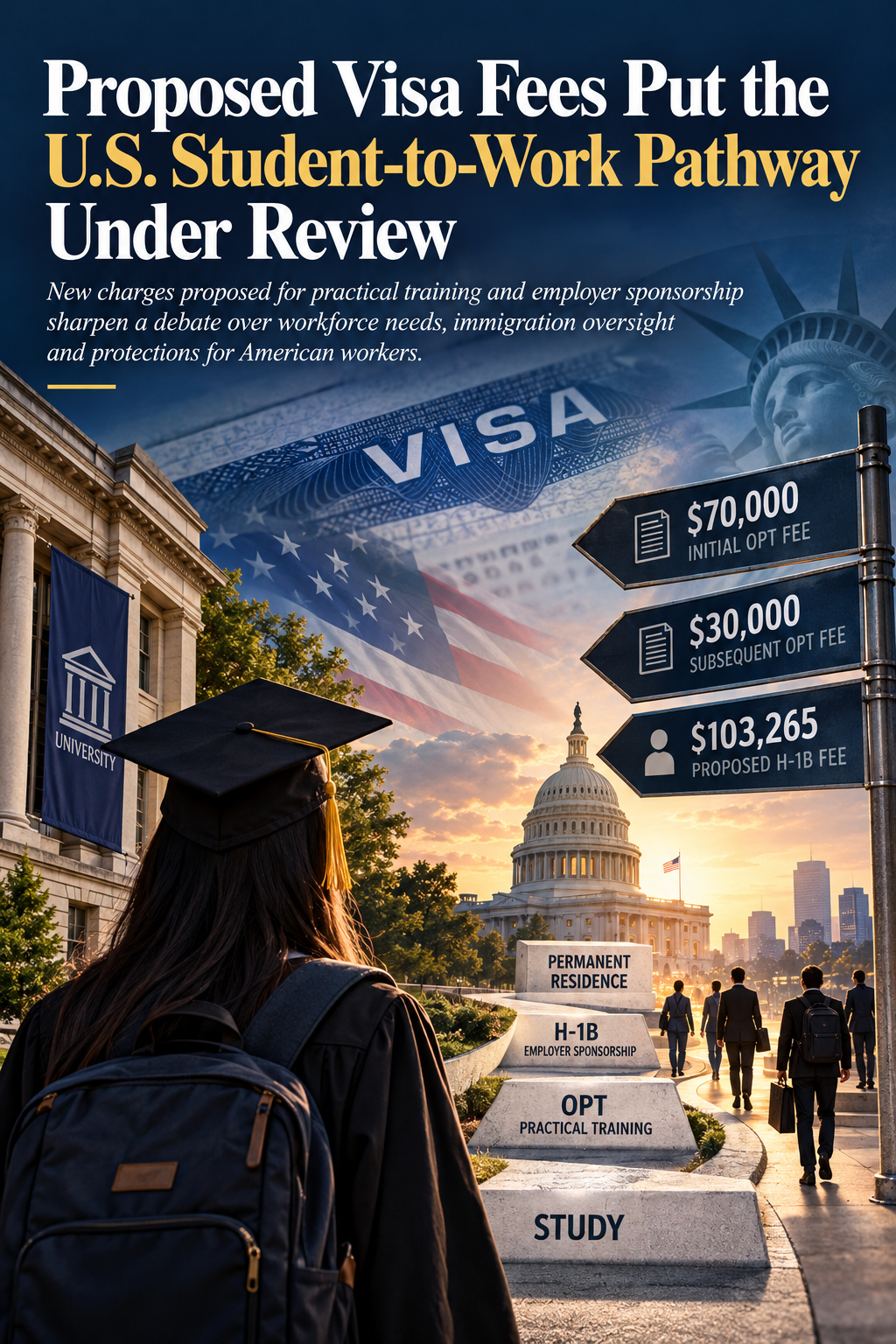
New charges proposed for practical training and employer sponsorship sharpen a debate over workforce needs, immigration oversight and protections for American workers.
A federal proposal to charge universities $70,000 before recommending an international student for an initial period of work training has brought new attention to the route from American higher education into the U.S. workforce.
Published October 8, the Department of Homeland Security proposal would also require $30,000 for subsequent Optional Practical Training recommendations. DHS says the measure is intended to combat fraud, strengthen immigration oversight and protect U.S. workers. The proposed payment obligation falls on participating educational institutions; how those institutions would finance it is a separate question. Public comments are due November 9. Federal Register proposal
The fees are not in effect. In an October 9 advisory, the University of Washington emphasized that existing OPT rules and authorizations remain unchanged and said it was coordinating an institutional response. University of Washington advisory
The proposal nevertheless adds a new consideration for students planning careers, universities advising graduates and employers assessing potential hires. It arrives alongside changes to H-1B selection, a separate proposed sponsorship fee and litigation over how long international students may remain in the country.
Together, these developments touch several stages of a process that is often discussed as though it were a single immigration pathway. It is not. Admission to a university, permission to undertake practical training, eligibility for employer sponsorship and approval for permanent residence are separate decisions.
In a September analysis, Fragomen counsel Susan Steger argued that employers experience those stages as a connected recruitment process, with uncertainty at one stage affecting decisions at the next. The October OPT proposal adds a development beyond those covered in that article. Fragomen’s analysis
The population potentially affected is substantial. The Institute of International Education’s Open Doors 2025 report counted approximately 1.18 million international students in the United States during the 2024–25 academic year, including OPT participants. Of that total, 294,253 were participating in OPT, up 21 percent from the previous year.
Other indicators showed slower recruitment. IIE’s separate fall 2025 survey found a 17 percent decline in new international enrollment among participating institutions. That survey is not a complete national census, and its findings predate the latest proposals. It cannot establish how the 2026 changes will affect enrollment. IIE’s enrollment findings
Education organizations have challenged the direction of the OPT proposal. In a published statement, Fanta Aw, executive director and CEO of NAFSA: Association of International Educators, said it “creates deep uncertainty for international students.” NAFSA argues that practical training supports workforce development and innovation and says it will submit detailed comments opposing the measure. The association advocates for international education; its assessment represents a stakeholder position rather than a measured outcome of the proposed rule. NAFSA statement
For graduates seeking longer-term employment, another change is already operating. A rule effective February 27 introduced wage-weighted selection for the fiscal year 2027 H-1B cap process. Registrations at the highest of four occupational wage levels receive four entries in the selection pool, compared with one at the lowest level. The classifications account for occupation and geographic location.
DHS says the approach encourages higher-paid, higher-skilled hiring while preserving opportunities across wage levels. For recent graduates, the practical significance is that the offered wage now influences selection chances. Lower-wage registrations remain eligible, but an employer’s willingness to sponsor a candidate does not guarantee selection. H-1B selection rule
Sponsorship costs could also change. In August, DHS proposed an additional $103,265 fee for cap-subject H-1B petitions, including those eligible for the U.S. advanced-degree exemption. The agency says the charge would recover a share of federal costs associated with administering lawful immigration. It remains a proposal. USCIS announcement
The American Society for Clinical Pathology has warned that the fee could make recruitment more difficult for affected hospitals, laboratories and medical practices, particularly in rural communities. It has sought healthcare exemptions. The organization also notes that the proposal would not apply to cap-exempt higher-education institutions and qualifying affiliated nonprofit or research organizations. Its concerns illustrate how the effects could differ by employer type and sector. ASCP’s assessment
Meanwhile, a separate rule replacing students’ “duration of status” framework with fixed admission periods was postponed by a federal court on September 14. MIT’s International Students Office reported that the existing framework remained in place pending further judicial action. That court-blocked measure should be distinguished from both active requirements and proposals awaiting final decisions. MIT’s litigation update
Whether tighter restrictions improve domestic employment outcomes is an empirical question, and earlier research offers a more complicated picture than either side’s broadest claims.
Economist Britta Glennon’s research, published in Management Science, found that restrictions on H-1B hiring prompted U.S. multinational companies to expand employment at foreign affiliates. The study identifies relocation as one possible response, particularly for businesses already operating internationally. It does not forecast the effects of the current proposals or establish how smaller, domestic employers would respond. Research findings
The immediate decisions now lie in regulatory proceedings and the courts. The longer-term assessment will require evidence about wages, domestic hiring, graduate employment, university participation and overseas investment.
For students and employers making plans today, the distinctions are concrete: wage-weighted H-1B selection has been implemented, the new OPT and H-1B fees remain proposed, and the student-duration rule has been blocked pending further court action. What happens next will determine both the cost of moving from study to employment and which institutions and employers are willing to support that transition.