
November 2026 Visa Bulletin: What the Latest Dates Mean for Green Card Applicants
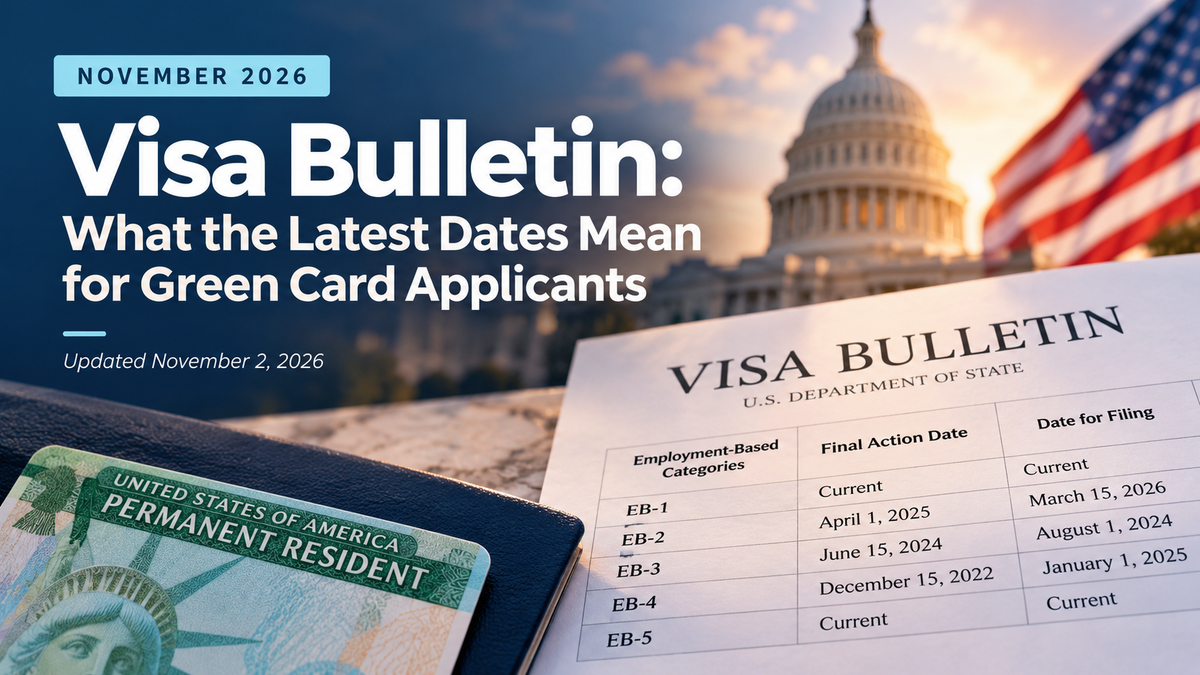
Updated November 2, 2026
The November 2026 Visa Bulletin brings forward movement in several family-sponsored and employment-based green card categories. For applicants waiting in line, these changes may bring their cases closer to the next stage.
However, a date advancing in the bulletin does not automatically mean an applicant can file a green card application or receive an approval. Those are separate milestones, governed by different charts and additional eligibility requirements.
This month’s update makes that distinction especially relevant: several approval cutoffs advanced, while many filing cutoffs remained unchanged. Boundless’s November overview.
What Is the Visa Bulletin?
The Visa Bulletin is the Department of State’s monthly publication showing immigrant visa availability in categories subject to numerical limits. It organizes availability by immigration category and country of chargeability.
The bulletin uses two charts:
- Final Action Dates: Cutoffs governing when an otherwise eligible case can receive final approval.
- Dates for Filing: Cutoffs that can allow an applicant to begin certain application or document-submission steps earlier.
The Department of State publishes the bulletin, while USCIS separately determines which chart applicants inside the United States must use to file adjustment of status applications. Department of State Visa Bulletin information.
Start With Your Priority Date
Your priority date establishes your place in the immigrant visa queue. It is not necessarily the date your petition was approved.
For employment-based cases, the date generally depends on whether labor certification is required:
- Cases requiring labor certification: The priority date generally comes from the filing of the labor certification application with the Department of Labor.
- Cases without that requirement: The priority date generally comes from the filing of the immigrant petition with USCIS.
This distinction matters when reviewing EB-3 employer-sponsored cases alongside categories that do not require labor certification. Applicants should confirm the date in their actual case records before comparing it with the bulletin. USCIS employment-based priority date explanation.
Which Country Column Applies?
Country of chargeability generally follows the applicant’s country of birth. It does not ordinarily change simply because someone obtains a different passport or moves to another country.
For example, an applicant born in Brazil generally uses the column labeled “All Chargeability Areas Except Those Listed,” because Brazil does not have its own column in the November bulletin.
Exceptions exist. In qualifying circumstances, an applicant may use a spouse’s country of birth through a process called cross-chargeability. The applicable rules should be reviewed before relying on a different country column. Department of State chargeability guidance.
November 2026 Employment-Based Cutoffs
The following dates apply to the All Chargeability Areas Except Those Listed column, which generally includes applicants chargeable to Brazil.
Employment category | Final Action Date | Date for Filing |
|---|---|---|
EB-1 | Current | Current |
EB-2 | April 1, 2025 | March 15, 2026 |
EB-3 professionals and skilled workers | June 15, 2024 | August 1, 2024 |
EB-3 Other Workers | June 1, 2022 | July 1, 2022 |
EB-4 | December 15, 2022 | January 1, 2025 |
EB-5 unreserved | Current | Current |
A priority date must be earlier than the applicable cutoff. A priority date equal to the listed date does not qualify under that cutoff.
“Current” means there is no priority-date cutoff for that category and country column; other eligibility requirements still apply. Official November 2026 Visa Bulletin.
Which Employment Categories Advanced?
Compared with October, November’s employment-based Final Action Dates show several advances:
- EB-2: Three months for the general country column, Mexico, and the Philippines.
- EB-3 professionals and skilled workers: One month for the general country column and Mexico.
- EB-3 Other Workers: Five months for the general country column and Mexico.
- EB-1 China: One month.
- EB-3 China and India: Approximately two and three weeks, respectively.
These changes concern approval cutoffs. Applicants should separately review the filing chart rather than assume that an advance creates a new filing opportunity. November employment-based update.
Which Chart Applies to Adjustment of Status in November?
For November 2026, USCIS selected the Dates for Filing chart for both family-sponsored and employment-based preference categories, as recorded by the American Immigration Lawyers Association.
This can allow otherwise eligible applicants to file Form I-485 before their priority dates become eligible for final approval.
Being within the filing cutoff addresses only the visa-availability component of filing. It does not establish that every other adjustment of status requirement has been met. Applicants should check USCIS’s monthly chart selection immediately before submitting an application. AILA’s record of the November USCIS chart selection.
What This Means for EB-2 NIW Applicants
The National Interest Waiver is part of the EB-2 classification. USCIS evaluates whether the applicant qualifies for EB-2 and whether the proposed endeavor satisfies the requirements for a national interest waiver. USCIS NIW policy update.
Visa availability remains a separate consideration.
Illustrative example: An EB-2 applicant chargeable to Brazil has a priority date of February 1, 2026. That date is earlier than November’s March 15, 2026 filing cutoff, but later than the April 1, 2025 Final Action Date. The applicant falls within the filing window, subject to other requirements, while final approval must wait for visa availability.
For EB-3 applicants, identifying the correct subcategory is equally important. Professionals and skilled workers have different cutoffs from Other Workers. November bulletin charts.
Family-Sponsored Categories Also Advance
November includes substantial movement in several family-sponsored categories. For the general country column, Final Action Dates advance approximately one year in F1, F2B, F3, and F4. F2A advances by one month.
The categories cover different relationships:
- F1: Unmarried adult sons and daughters of U.S. citizens.
- F2A: Spouses and unmarried children under 21 of permanent residents.
- F2B: Unmarried adult sons and daughters of permanent residents.
- F3: Married sons and daughters of U.S. citizens.
- F4: Siblings of adult U.S. citizens.
Movement varies by country. An applicant should compare the exact category and country column rather than rely on a general headline about family-based advances. Family-category definitions and November overview.
How Consular Processing Differs
Applicants completing their cases through a U.S. embassy or consulate follow the National Visa Center’s instructions after petition approval. NVC collects the required fees, forms, and supporting documents and holds the case until an interview can be scheduled. National Visa Center overview.
Completing the document stage does not guarantee an immediate interview. For preference cases, visa availability remains necessary, and scheduling also depends on the embassy or consulate’s capacity.
The Department of State’s interview scheduling tool explains that an applicant’s priority date must be earlier than the applicable Final Action Date, or the category must be current, to receive an interview appointment. The filing chart therefore should not be treated as a promise of an interview or visa issuance. Department of State interview scheduling guidance.
Can the Dates Move Backward?
Yes. Cutoff dates can move backward, a development known as retrogression.
If an adjustment of status application is ready for a decision but the applicant’s priority date no longer meets the applicable cutoff, USCIS may hold the case until an immigrant visa becomes available again. Filing while eligible does not guarantee that visa availability will remain unchanged throughout processing. USCIS explanation of retrogressed cases.
The bulletin also cannot provide a reliable approval forecast. A three-month advance in a cutoff does not mean every affected applicant’s remaining wait has shortened by exactly three months.
USCIS processing times depend on additional factors, including workload, staffing, requests for information, and operational changes. Visa availability and case processing are related but separate parts of the timeline. USCIS processing-time explanation.
What Applicants Should Review This Month
Before taking action, applicants should confirm their preference category, priority date, country of chargeability, and processing route. Those four details determine which part of the bulletin applies.
For adjustment of status, review USCIS’s monthly filing-chart selection. For consular processing, follow NVC instructions and check the applicable Final Action Date before drawing conclusions about interview timing.
November’s advances may create meaningful progress for some applicants. The practical next step is to compare the correct date and chart with the individual case records, then determine whether the case is ready for filing, continued preparation, or final adjudication.
This article provides general information about the November 2026 Visa Bulletin and is not individualized legal advice.