
Major Immigration Change: BIA Rules That Travel on Advance Parole Can Trigger the 10-Year Unlawful Presence Bar
A Significant New BIA Decision on Advance Parole
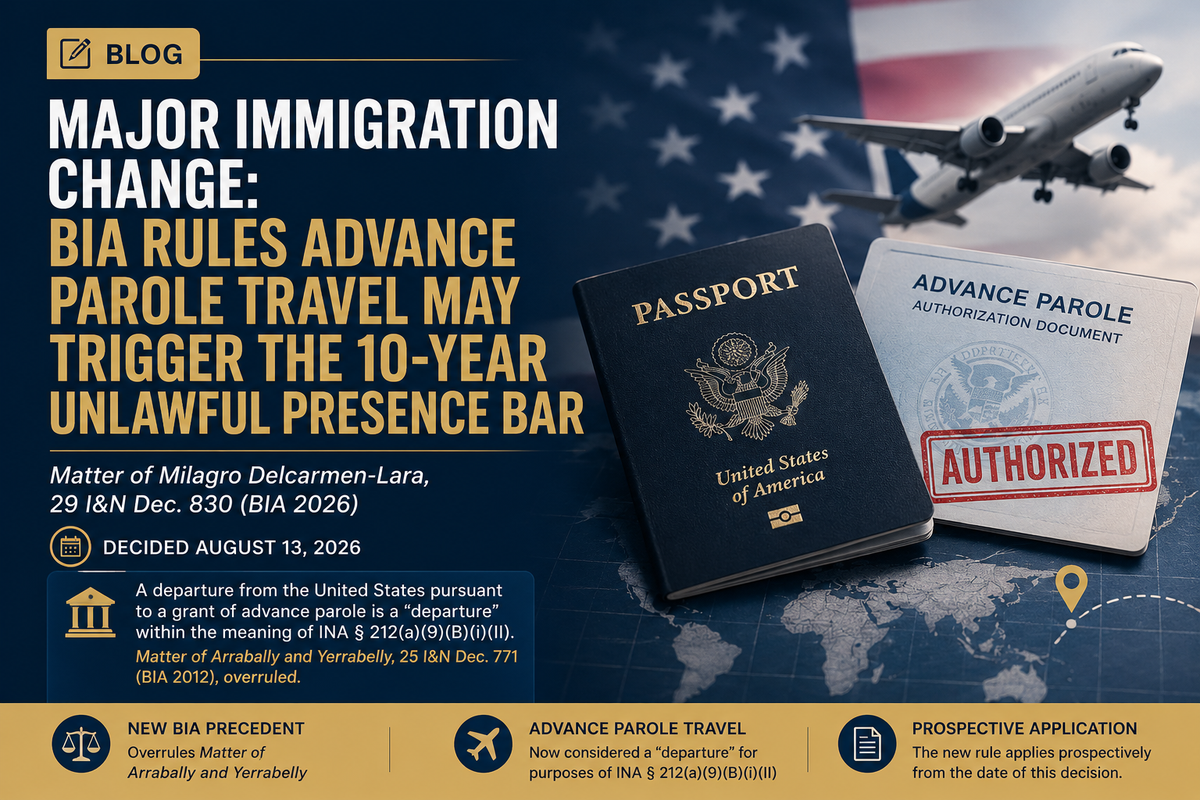
On August 13, 2026, the Board of Immigration Appeals (BIA) issued a significant precedent decision that changes how certain departures from the United States under Advance Parole may be treated for purposes of the unlawful presence bars.
In Matter of Milagro Delcarmen-Lara, 29 I&N Dec. 830 (BIA 2026), the BIA held that a person who leaves the United States pursuant to a grant of Advance Parole has made a “departure” for purposes of section 212(a)(9)(B)(i)(II) of the Immigration and Nationality Act (INA).
In reaching this conclusion, the BIA expressly overruled its longstanding precedent in Matter of Arrabally and Yerrabelly, 25 I&N Dec. 771 (BIA 2012).
This development may have important consequences for certain individuals who have accumulated unlawful presence in the United States and are considering international travel using Advance Parole.
What Was the Rule Before This Decision?
Since 2012, Matter of Arrabally and Yerrabelly had provided an important interpretation concerning travel with Advance Parole.
Under that decision, a temporary trip outside the United States pursuant to a grant of Advance Parole was not considered a “departure” that triggered the unlawful presence ground of inadmissibility under INA § 212(a)(9)(B)(i)(II).
That distinction was particularly important for certain adjustment-of-status applicants who had accumulated unlawful presence before receiving Advance Parole.
What Did the BIA Change?
In Matter of Delcarmen-Lara, the BIA reconsidered the meaning of the word “departure” under the INA.
The Board concluded that the statutory language does not contain an exception for individuals who temporarily leave the United States using Advance Parole.
As a result, the BIA held that:
A departure from the United States pursuant to a grant of Advance Parole is a “departure” for purposes of INA § 212(a)(9)(B)(i)(II).
The Board therefore expressly overruled Matter of Arrabally and Yerrabelly.
Why Does This Matter?
Under INA § 212(a)(9)(B)(i)(II), an individual who has been unlawfully present in the United States for one year or more and then departs may be inadmissible when seeking admission again within 10 years of that departure.
The new BIA decision means that, in cases where this provision applies, traveling internationally with Advance Parole may now constitute the departure that triggers the 10-year unlawful presence bar.
This is an important change because obtaining Advance Parole does not, by itself, mean that international travel will be free of immigration consequences.
Does This Mean Everyone With Advance Parole Should Avoid Travel?
No. The decision does not mean that every person who has Advance Parole will automatically become inadmissible by traveling.
Immigration consequences depend on the individual’s specific circumstances, including:
- The amount and timing of any unlawful presence in the United States;
- The person’s immigration history;
- How and when the person entered the United States;
- The basis for the Advance Parole;
- Whether other grounds of inadmissibility may apply;
- Whether the person may qualify for a waiver or another form of relief; and
- The timing of the proposed departure.
The decision specifically addresses the meaning of “departure” in connection with the unlawful presence ground under INA § 212(a)(9)(B)(i)(II). It should therefore not be interpreted as creating the same consequence for every Advance Parole traveler.
An Important Detail: The BIA Applied the New Rule Prospectively
One particularly important part of the decision concerns retroactivity.
Because the BIA was overruling a longstanding precedent on which individuals may have relied, the Board conducted a retroactivity analysis and determined that the new rule should be applied prospectively.
The BIA recognized that its new interpretation represents a significant change concerning both the meaning of “departure” and potential eligibility for adjustment of status.
This distinction may be extremely important when evaluating travel that occurred before the issuance of the new decision versus travel occurring after the new rule.
Advance Parole Is Not a Guarantee of Admission
Advance Parole has always required careful consideration.
Authorization to travel does not guarantee that a person will ultimately be found admissible to the United States or that travel will have no effect on a pending immigration case.
Following Matter of Delcarmen-Lara, individuals with a history of unlawful presence should be particularly cautious before departing the United States, even if they have already received an approved Advance Parole document.
What Should Advance Parole Holders Do Now?
Individuals who have accumulated unlawful presence in the United States should consider obtaining individualized legal advice before traveling internationally with Advance Parole.
This is especially important for people with pending adjustment-of-status applications who may have previously assumed that Advance Parole travel would not trigger the unlawful presence bar based on Matter of Arrabally and Yerrabelly.
Because immigration histories vary significantly from person to person, the effect of the new decision must be evaluated on a case-by-case basis.
Final Considerations
Matter of Delcarmen-Lara represents a major change in the interpretation of Advance Parole travel and the unlawful presence provisions of U.S. immigration law.
The BIA has now made clear that a temporary departure under Advance Parole can constitute a “departure” for purposes of INA § 212(a)(9)(B)(i)(II), expressly overruling the rule established in Matter of Arrabally and Yerrabelly.
For individuals who have accumulated significant unlawful presence, international travel should therefore be carefully evaluated before departure.
If you have Advance Parole and are considering international travel, speak with a qualified immigration attorney before leaving the United States to understand how this new decision may affect your specific immigration history and pending applications.
This article is provided for general informational and educational purposes only and does not constitute legal advice. Immigration laws and policies are subject to change, and the application of the law depends on the specific facts of each case.