
DHS Final Rule Ends "Duration of Status" for F, J, and I Visa Holders: What International Students and Exchange Visitors Need to Know
By American Immigration Associates
In a significant change to U.S. immigration policy, the Department of Homeland Security (DHS) has announced a final rule ending the long-standing "Duration of Status" (D/S) admission framework for F-1 students, J-1 exchange visitors, and I visa holders (foreign media representatives).
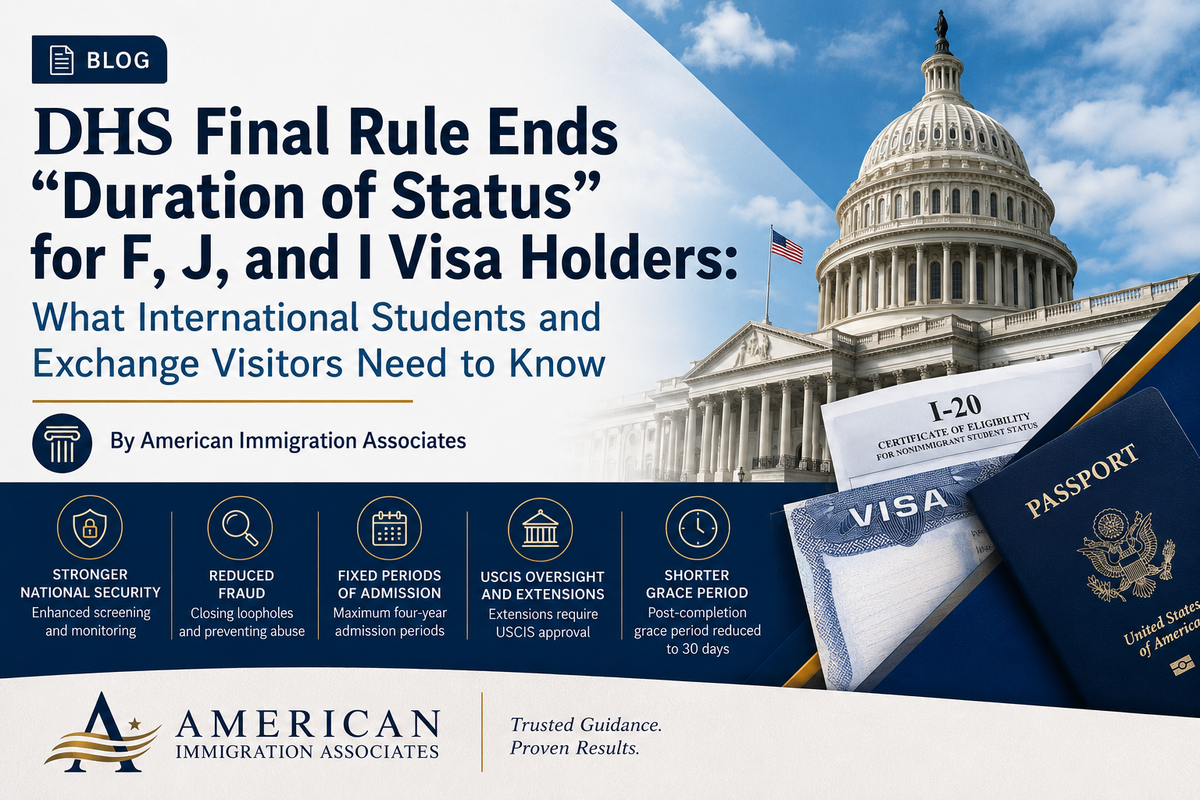
According to DHS, the rule is intended to strengthen national security, reduce immigration fraud, and increase federal oversight by replacing the indefinite admission model with fixed periods of authorized stay.
The regulation is expected to take effect 60 days after publication in the Federal Register and will fundamentally change how international students and exchange visitors maintain lawful status in the United States.
What Is Changing?
For decades, most F-1 and J-1 visa holders were admitted under "Duration of Status" (D/S), allowing them to remain in the United States as long as they continued to comply with the terms of their educational or exchange program.
Under the new rule, that system will end.
Instead, eligible nonimmigrants will receive a fixed period of admission, similar to many other temporary visa classifications.
Maximum Four-Year Admission Period
One of the most significant changes is the implementation of a maximum admission period.
Under the new regulation:
- F-1 students will generally be admitted for the duration of their approved academic program, not to exceed four years.
- J-1 exchange visitors will also receive admission for the length of their approved exchange program, subject to the same four-year maximum.
Rather than remaining in the United States indefinitely while maintaining status, international students will now have a clearly defined expiration date for their authorized stay.
Extensions Will Require USCIS Approval
Students who require additional time to complete their academic programs will no longer rely solely on school officials to extend their stay.
Instead, they must file an Application for Extension of Stay (EOS) directly with U.S. Citizenship and Immigration Services (USCIS).
This new process includes:
- Federal review of the request;
- Biometric collection, when required;
- Background checks;
- Fraud detection screening; and
- Formal USCIS adjudication before additional time is granted.
This change transfers much of the oversight authority from educational institutions back to the federal government.
Shorter Grace Period After Graduation
The final rule also reduces the post-completion grace period for F-1 students.
Currently, most F-1 students receive 60 days following program completion to:
- Prepare to depart the United States;
- Transfer to another educational institution; or
- File an application to change immigration status.
Under the new regulation, this grace period will be reduced to 30 days.
Students should begin planning their next immigration steps well before completing their academic programs to avoid falling out of status.
Additional Restrictions on Academic Changes
The regulation introduces stricter controls over changes to educational programs.
Although DHS has not yet released every implementation detail, the agency indicates that changing academic programs, extending studies, or modifying educational objectives will involve greater federal scrutiny than under the previous system.
Current Students Will Also Transition
Importantly, these changes do not apply only to future arrivals.
Current F-1, J-1, and I visa holders already present in the United States under the previous "Duration of Status" framework will also transition to the new system.
According to DHS, their authorized stay will automatically convert to a fixed admission period, generally not exceeding four years from the rule's effective date.
Students currently studying in the United States should monitor future guidance carefully to understand how this transition may affect their individual immigration status.
Why DHS Implemented the Rule
DHS states that the purpose of the regulation is to:
- Increase national security;
- Improve immigration screening and monitoring;
- Reduce visa fraud;
- Prevent abuse by individuals who repeatedly enroll in educational programs solely to remain in the United States; and
- Ensure periodic federal review of nonimmigrant students and exchange visitors.
According to DHS, the previous "Duration of Status" system had remained largely unchanged since 1978 and no longer reflected the government's current security and enforcement priorities.
What International Students Should Do Now
Although the rule has been finalized, implementation will occur after its effective date. Students and exchange visitors should begin preparing now by:
- Reviewing the expiration dates of their immigration documents;
- Planning academic completion timelines carefully;
- Maintaining continuous compliance with all immigration requirements;
- Consulting with their Designated School Official (DSO) regarding program completion; and
- Seeking experienced immigration counsel before filing any extension or change of status applications.
Early planning will become increasingly important under the new framework, particularly for students pursuing graduate degrees, research programs, or academic pathways that may extend beyond the initial admission period.
Final Thoughts
This rule represents one of the most significant changes to student immigration policy in decades. By replacing the "Duration of Status" model with fixed admission periods and mandatory USCIS extensions, DHS is fundamentally changing how international students maintain lawful status in the United States.
As the implementation date approaches, educational institutions and international students alike should closely monitor additional guidance from DHS and USCIS to ensure continued compliance with the new requirements.
If you are an F-1 student, J-1 exchange visitor, or educational institution and have questions about how these changes may affect your immigration status, our team at American Immigration Associates is available to provide strategic guidance and individualized legal advice.