
DHS Authorizes USCIS to Require Electronic Filing for Eligible Immigration Benefit Requests
Executive Summary
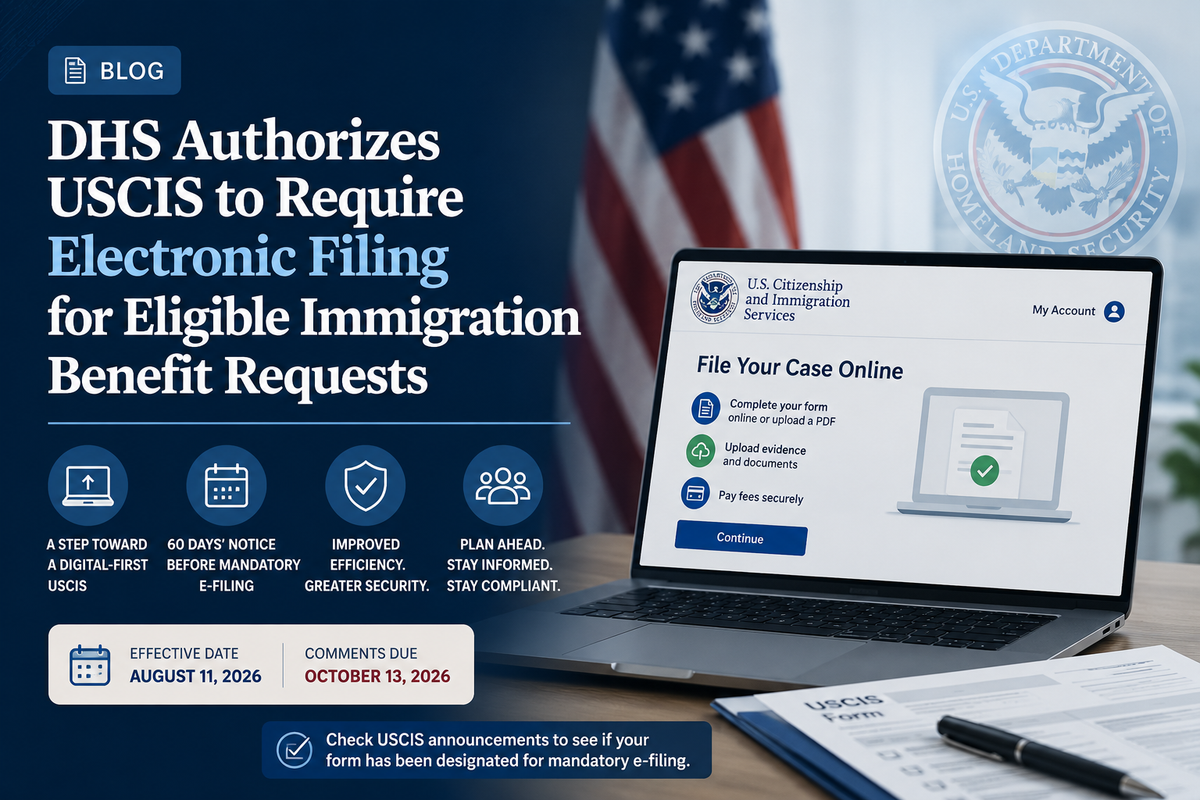
The Department of Homeland Security (DHS) has issued an Interim Final Rule (IFR) authorizing U.S. Citizenship and Immigration Services (USCIS) to require electronic filing for immigration benefit requests that have been available for online filing for at least 180 days.
The rule does not, by itself, make any particular form mandatory for online submission. Instead, it establishes a framework under which USCIS may designate individual forms for mandatory e-filing after providing at least 60 days’ advance notice on its website. The IFR is effective August 11, 2026, and public comments are due by October 13, 2026.
What the Rule Does
Once USCIS designates an eligible form for mandatory electronic filing, requestors will be required to submit it through a USCIS online account. Depending on the form and filing pathway, the requestor may complete the form within the online system or upload a completed PDF with supporting evidence.
DHS expects the initiative to reduce the agency’s dependence on physical lockbox operations and move more filing-fee transactions to electronic payment channels. The agency also identifies operational benefits associated with electronically submitted data, including more efficient intake, storage, retrieval, and analysis of immigration-benefit information.
No Forms Have Yet Been Identified for Mandatory E-Filing
The most important practical point is that the IFR does not identify forms that must now be filed online. A form may become subject to a mandatory e-filing requirement only after it has been available online for at least 180 days and USCIS separately announces the requirement at least 60 days before implementation.
Employers, individuals, and their representatives should therefore continue to follow the filing instructions for the specific form at issue, including USCIS’s current online-filing availability guidance. Organizations with high-volume USCIS filing programs should also monitor USCIS announcements closely, as a future designation could require changes to intake procedures, signature protocols, evidence collection, fee-payment practices, and representative-account workflows.
Expected Operational and Compliance Effects
DHS states that electronic filing may improve fraud detection, identity management, and national-security screening by making case data more readily accessible and usable for analytical purposes. The agency also anticipates that e-filing will reduce incomplete filings and data-entry errors and may improve adjudication efficiency.
For employers and immigration practitioners, the shift raises several practical considerations:
- Online-account access and account-governance procedures should be documented and maintained.
- Filing teams should confirm how representative filings, signatures, evidence uploads, and fee payments will operate for each affected form.
- Internal calendars should track USCIS form-specific announcements and implementation dates.
- Filing processes should preserve records demonstrating timely submission and retain copies of all uploaded materials and confirmations.
Hardship Waivers
The rule recognizes that electronic filing may not be workable in every case. A requestor unable to file electronically may request a waiver based on undue hardship. Such waivers are discretionary, and requestors should not assume that a paper submission will be accepted without USCIS approval where e-filing has been made mandatory.
Takeaway
The IFR represents a significant step toward a broader digital-first USCIS filing environment, but it is not an immediate universal online-filing mandate. The operative question for any case will remain whether USCIS has specifically designated the relevant form for mandatory e-filing and whether the designation has taken effect.
Stakeholders should use the coming comment period and future USCIS notices to assess how mandatory e-filing may affect their filing practices. The full text is available in the DHS interim final rule.