
Beyond Music and Dance: How the P-3 Visa Opens Doors for Brazilian Cultural Professionals in the United States
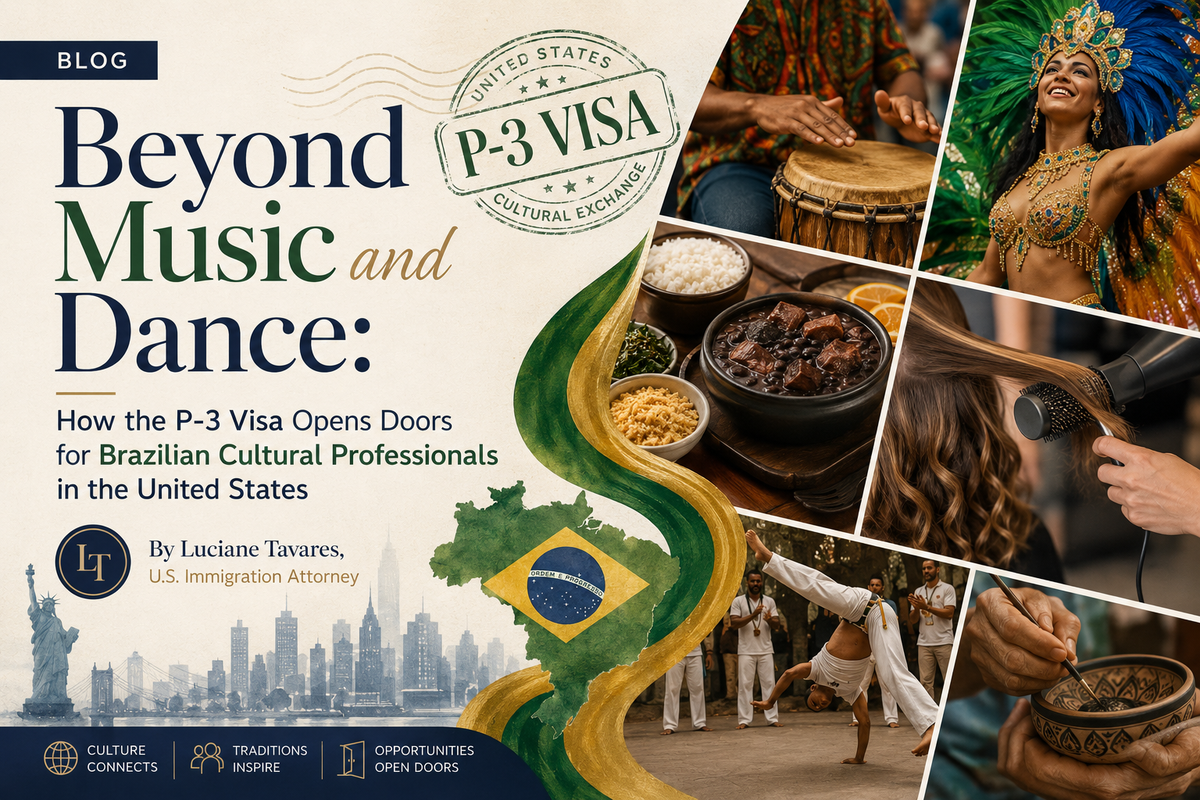
By Luciane Tavares, U.S. Immigration Attorney
When people think about work visas for artists, they often imagine internationally famous musicians or Hollywood actors. However, U.S. immigration law provides another fascinating pathway for professionals whose work preserves and promotes the culture of their home country: the P-3 Visa.
Although not as widely known as the O-1 visa, the P-3 visa has become an excellent option for Brazilian professionals who teach, perform, or demonstrate culturally unique traditions in the United States.
What is the P-3 Visa?
The P-3 visa is designed for artists and entertainers who come to the United States temporarily to perform, teach, coach, or present a culturally unique artistic tradition.
The program may be commercial or nonprofit. The essential requirement is that the work helps promote, preserve, or educate others about a cultural tradition that is unique to a particular country, ethnicity, or community. (USCIS)
Contrary to popular belief, the visa is not limited to musicians or dancers. Many professions can qualify when their work is closely connected to a country’s cultural heritage.
Who Can Qualify?
Examples include:
• Traditional musicians
• Folk dance groups
• Capoeira instructors
• Samba performers
• Carnival artists
• Cultural educators
• Indigenous artisans
• Culinary professionals specializing in authentic regional cuisine
• Beauty professionals who teach traditional cultural techniques
• Cultural festival organizers
• Traditional theater performers
The key is demonstrating that the applicant’s work represents a culturally unique form of artistic expression and that the U.S. events will further the understanding or appreciation of that cultural tradition. (USCIS)
Brazilian Cuisine as Cultural Heritage
One of the most rewarding P-3 cases our office handled involved a Brazilian chef.
At first glance, many people assume that cooking cannot qualify under a cultural visa. However, authentic Brazilian cuisine represents centuries of cultural history, regional traditions, indigenous influences, Portuguese heritage, and African culinary techniques.
Our petition demonstrated that the chef was not simply preparing meals. Instead, he was teaching authentic Brazilian cooking methods, presenting traditional recipes, and helping American audiences experience Brazilian culinary culture through educational events and cultural programs.
By documenting the cultural significance of the cuisine, the educational nature of the events, and expert opinions regarding Brazilian gastronomy, we were able to establish that the work met the requirements of the P-3 classification.
Beauty Professionals Can Also Qualify
Another successful petition involved a Brazilian hair professional.
Again, many people are surprised that hairstylists may qualify under the P-3 category. However, Brazilian beauty techniques have earned worldwide recognition and have become closely associated with Brazil’s cultural identity.
In this case, the professional was invited to demonstrate and teach authentic Brazilian hairstyling techniques during educational beauty events in the United States.
The petition focused not only on technical expertise but also on how these techniques represent a distinctive part of Brazilian beauty culture and professional education. By documenting the cultural importance of these methods and the educational purpose of the events, the petition successfully established eligibility under the P-3 visa category.
What Evidence Is Required?
Every case is unique, but successful P-3 petitions generally include:
• A detailed itinerary of cultural events.
• Contracts with U.S. organizations or sponsors.
• Expert opinion letters confirming the cultural uniqueness of the art form.
• Evidence that the performances or educational activities promote cultural understanding.
• Articles, publications, or documentation demonstrating the authenticity of the cultural tradition.
• A consultation from the appropriate labor organization, when required. (USCIS)
More Than Entertainment
One of the most interesting aspects of the P-3 visa is that it recognizes culture itself as something worth preserving and sharing.
Whether through music, dance, food, visual arts, beauty traditions, or other authentic cultural expressions, the visa allows talented professionals to bring a piece of their country’s heritage to audiences in the United States.
For Brazil, whose cultural richness is admired throughout the world, this creates opportunities for professionals who may never have considered themselves eligible for a U.S. work visa.
Sometimes the greatest qualification is not celebrity status, but the ability to preserve, teach, and celebrate a tradition that is uniquely Brazilian.
As immigration attorneys, one of the most rewarding parts of our work is identifying creative legal pathways that allow talented individuals to share their culture internationally while complying with U.S. immigration law. The P-3 visa is an excellent example of how immigration law can promote cultural exchange and create meaningful opportunities for artists, educators, chefs, and other cultural professionals.
For many Brazilian professionals, the opportunity to work in the United States may be much closer than they realize.